
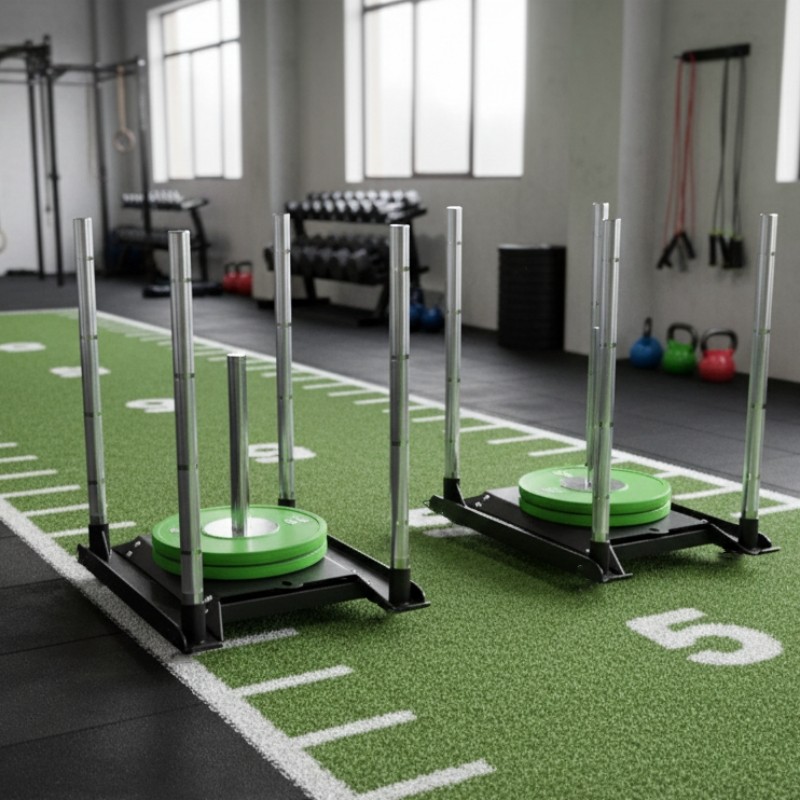
What Defines a "Competition Sled"? It's More Than Just a Sled.
Not all workout sleds are created equal. A "competition" model is engineered to a much higher standard, and these differences are key selling points
- Weight Capacity and Unyielding Construction: A true competition sled is built from thicker, heavier-gauge steel with superior welds. It's designed to be loaded with an immense amount of push sled weight—often 500, 700, or even 1,000 pounds. This is essential for training elite athletes who need to push beyond the limits of a standard, lighter-duty sled.
- Versatile, Multi-Height Push Poles: Competition models feature both high and low push-handle options. This is not just an incidental feature. The low handles force the athlete into a deeper, more athletic forward lean, which is ideal for developing acceleration and speed. The high handles allow for a more upright posture, which is better for targeting the quads and for general conditioning. This versatility allows one tool to be used for multiple training goals.
- The Harness and Pulling Attachments: A competition sled is also a versatile pulling tool. reinforced attachment points for straps and harnesses. This allows it to be used for a huge variety of movements, from forward sprints to backward drags and lateral pulls.
Training for SPEED: The Art of Resisted Sprinting
This is one of the most valuable applications for athletic development. The goal here is to improve acceleration and explosive power.
The Execution: The athlete performs short, explosive sprints. The focus should be on a powerful forward lean and an aggressive leg drive, pushing the ground away.
Distance: Short sprints of 10-20 yards are ideal for focusing on pure acceleration.
Volume and Rest: This is speed training, not conditioning. The volume should be low (e.g., 6-10 sprints), and the rest periods should be long (2-3 minutes or more) to ensure full recovery and maximum quality for every single rep.
Training for POWER: The Heavy Push for Strength-Speed
The goal here is to improve the ability to generate force quickly, which is the definition of power. This is where heavy sled pushes come in.
- The Setup: The sled should be loaded with Weight Plate. The athlete should use the low push handles to get into a deep, forward-leaning position.
- The Execution: The focus is on a powerful, rhythmic leg drive. Each step should be a violent, explosive push. The athlete should aim to accelerate the sled and maintain its momentum.
Distance: Short pushes of 15-25 yards are perfect. The goal is to maintain maximum power output, which cannot be sustained for long durations.
Volume and Rest: This is strength work. The volume should be moderate (e.g., 5-8 sets), and the rest periods should be long enough for near-full recovery (2-4 minutes).
Training for CONDITIONING
This is where the sled becomes a tool for building metabolic capacity and mental toughness. The goal is to sustain a high work rate for an extended period.
- The Setup: The load should be moderate to light. The athlete should be able to move the sled continuously without stopping for the entire duration of the work interval. They can use any technique: high pushes, low pushes, forward drags, backward drags, etc.
- The Execution: The key is relentless, continuous movement. The goal is not maximum speed, but a steady, grueling pace. This type of training creates an immense metabolic demand and is incredibly effective for fat loss and improving cardiovascular fitness.
- The Programming: This is where you can get creative with high-intensity interval training (HIIT).
Sled Suicides: Mark out lines at 10, 20, and 30 yards. The athlete pushes the sled to the 10-yard line and back, then to the 20 and back, then to the 30 and back. That is one round. Rest and repeat.
EMOM (Every Minute on the Minute): At the start of each minute, the athlete pushes the sled for a set distance (e.g., 20 yards). The time remaining in that minute is their rest. They repeat this for 10-20 minutes.
Push/Pull Combinations: The athlete pushes the sled 25 yards down the turf, then immediately grabs a rope or strap and pulls it 25 yards back.
Contact us today to discuss your project needs and to receive a quote