
Let’s be honest about what happens in a badly designed gym.
It’s 6:00 PM on a Tuesday. The "after-work" rush. You have 20 members trying to do a workout that combines back squats and pull-ups. If the gym layout relies on scattered squat stands and random pull-up bars bolted to different walls, you have chaos. People are crossing paths, barbells are colliding, coaches are losing control of the floor, and the energy is frantic—not focused.
The solution to this chaos is the Multi-Station Rig.
For you—the distributor, the dealer, the facility designer—the rig is not just a piece of equipment. It is the architectural spine of the business. It dictates the flow, the safety, and ultimately, the profitability of the facility. When a client asks you, "How do I fit more people in my classes?", the answer isn't about buying a bigger building. It's about building a smarter rig.
In this guide, we are going to cut through the noise. We aren't just talking about steel uprights; we are going to talk about the strategy of High-Volume Training Spaces.
The "Pod" Philosophy: Why Multi-Station Rigs Work
In a high-efficiency group class, movement is the enemy. You don't want athletes walking 20 feet to get a plate, then 10 feet to the pull-up bar, then back to the rack. That transition time kills intensity and creates traffic jams.
A well-built multi-station rig creates self-contained "Pods." In a single 4-foot by 6-foot footprint, an athlete has:
- A Rack: For heavy lifting.
- A Pull-Up Station: For gymnastics.
- Storage: For their weights and collars.
- Accessories: For wall balls or dips.
The Foundation – Freestanding vs. Wall-Mounted
The Freestanding "Traffic Hub"
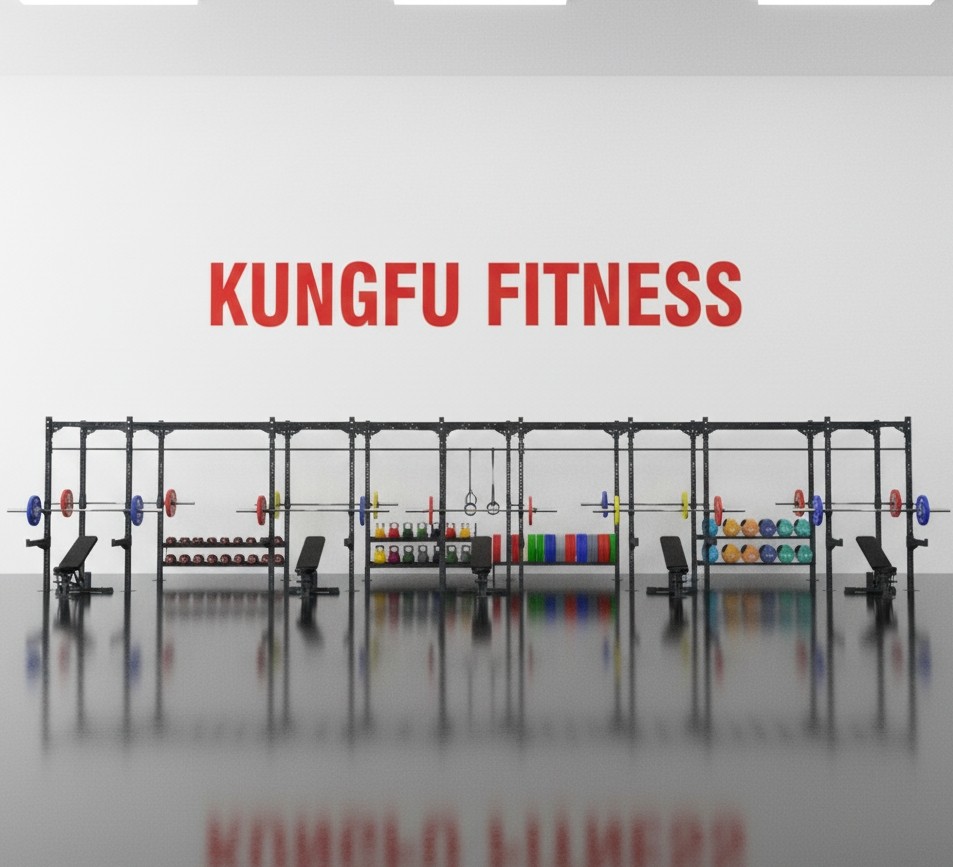
If your client has a facility that is wider than 30 or 40 feet, the Freestanding Rig is the gold standard.
- The Double-Sided Multiplier: This is simple math. A freestanding rig is accessible from both sides. A 24-foot rig gives you 6 squat stations on the front and 6 on the back. That’s 12 stations in one footprint.
- The Coaching Lane: By placing the rig in the center, you create a natural "track" around it. Coaches can walk the perimeter or walk inside the rig (the "corridor"), giving them 360-degree visibility of every athlete.
The Wall-Mounted "Space Saver"
If the facility is narrow, the Wall-Mount is the necessary choice.
- Preserving the Open Floor: By anchoring the rig to the wall, you sacrifice half the capacity (you lose the back side), but you gain the center of the room. This is crucial if the gym needs to run sleds, sprints, or large warm-up circles in the middle of the floor.
The Geometry of Safety – 4-Foot vs. 6-Foot Sections
This is the technical detail that separates the pros from the amateurs. When designing a rig, you are working with modular sections. The temptation is to just put 4-foot section after 4-foot section to cram in as many squat racks as possible.
The Problem with Continuous 4-Foot Sections
A barbell is 7 feet long. If you place two squat racks 4 feet apart (sharing an upright), the plates of the barbells are dangerously close. If one athlete stumbles, or if they are doing wide movements like butterfly pull-ups, they will crash into their neighbor.
The Problem with Continuous 4-Foot Sections
A barbell is 7 feet long. If you place two squat racks 4 feet apart (sharing an upright), the plates of the barbells are dangerously close. If one athlete stumbles, or if they are doing wide movements like butterfly pull-ups, they will crash into their neighbor.
The Solution: The Alternating Pattern
The professional standard for group training rigs is the 4ft – 6ft – 4ft pattern.
- The 4-Foot Bay: This is the Squat Station. It fits the barbell perfectly.
- The 6-Foot Bay: This is the Buffer Zone and Pull-Up Station.
Verticality – Configuring Height for Function
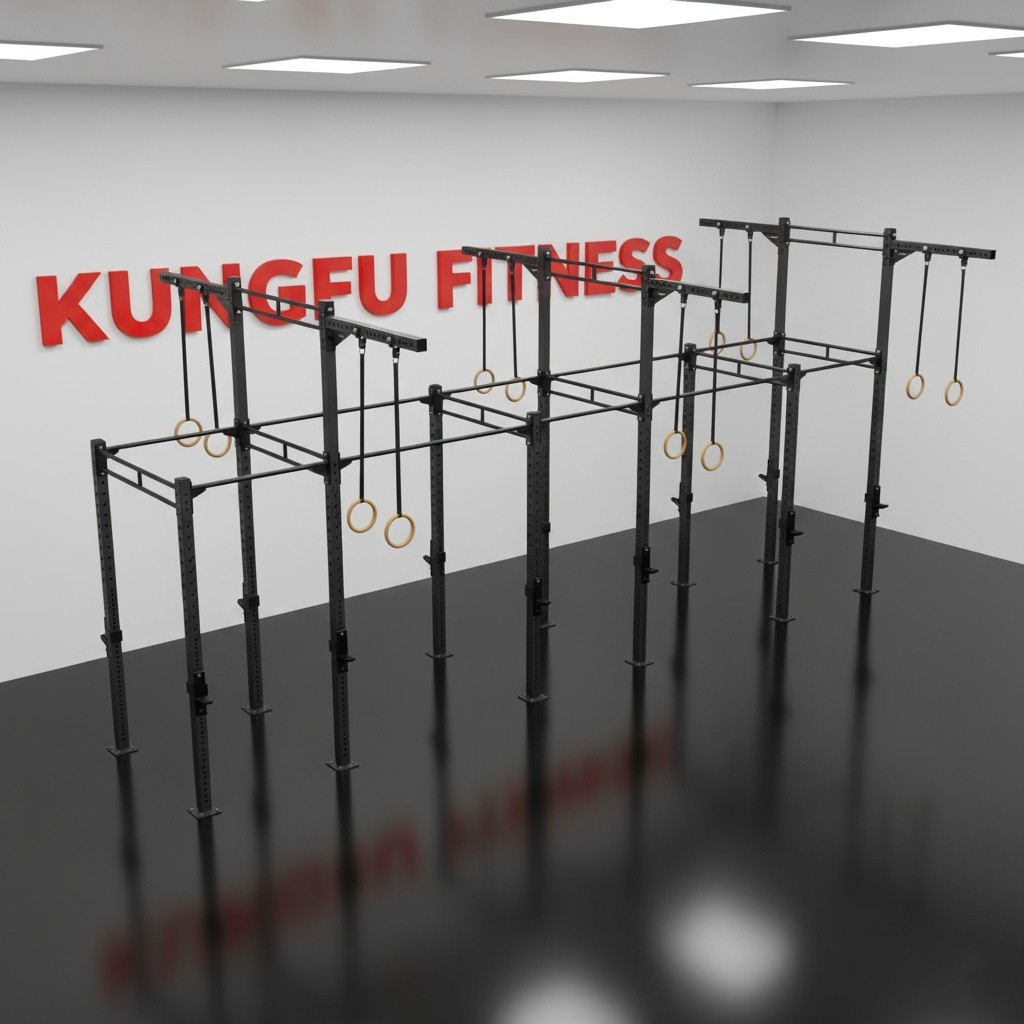
How tall should this beast be? Standard uprights are typically 9 feet (2.7 meters). This works for 90% of movements. But you need to ask your client about their programming.
The Muscle-Up Requirement
f they program Ring Muscle-Ups or Rope Climbs, 9 feet isn't enough. You need 12-foot (3.6 meter) uprights.
Design Tip: You don't need the whole rig to be a skyscraper. You can alternate heights. Use standard 9ft uprights for the squat stations, and place 12ft uprights every few sections to create dedicated "high" stations for rings.
The Ecosystem – Attachments that Drive Efficiency
The Liability Protectors (Must-Haves)
- Safety Spotter Arms: In a class of 20 people, the coach cannot spot everyone. Spotter arms are non-negotiable for safety during heavy lifting.
- J-Cups: Never sell steel-on-steel J-cups. They ruin barbells. Always spec J-cups with plastic liners
The Workflow Enhancers
- Wall Ball Targets: Without these, athletes throw medicine balls against the drywall or structural beams. This destroys the facility. Bolt-on targets (at 9ft and 10ft) save the building and standardize the movement.
- Plate Storage Channels: This is the biggest efficiency hack. By bolting weight storage directly to the rig uprights, you keep the floor clear. No more tripping hazards. No more walking across the gym to get a 45lb plate.
The "Wow" Factor
- Flying Pull-Up Ladders: These bridge the gap between two sides of a rig at a 45-degree angle. They look incredible and offer advanced gymnastics training.
- Landmine Attachments: Simple pivot points at the base of the rig that unlock dozens of rotational exercises.
Finish and Durability
Texture Matters: A glossy paint job is slippery. You need a textured powder coat. It holds chalk, provides grip, and hides the inevitable scratches from J-cups.
Outdoor Rigs: If this rig is going outside, powder coat is not enough. It must be galvanized first. Explain to your client: Galvanization protects the inside of the tube; powder coat protects the outside. You need both for outdoor survival.
Let's Design Your Perfect Gym Layout
Are you ready to optimize your facility with a custom Multi-Station Rig? Or are you a distributor looking for a manufacturer that understands the nuances of functional fitness design?
At Rizhao Kungfu Fitness, we don't just sell metal; we provide solutions. Our team can help you configure the perfect rig layout, choose the right attachments, and ensure your facility is built for success.
Contact us today for a consultation and wholesale pricing.